Edwige Crucifix

Current Projects
In Other Words:
Francophone Jewish Women’s Literature in the Mediterranean (1860-1962)
FIAS Fellowship
On 24 October 1870, a two-sentence decree penned by Minister of Justice Adolphe Crémieux granted French citizenship to the Jews of Algeria, forever changing the course of history. Beyond its colonies, France’s influence in the Mediterranean relied on the embrace of its language and culture – an enterprise that radically transformed women’s lives. From the founding of the Alliance Israélite Universelle to the end of the colonial empire, this project reconstructs the overlooked literary history of Mediterranean Jewish women, acknowledging them as the first generation of francophone women writers. As the first transcultural study of this corpus, the project draws on archival research conducted in France, North Africa, Turkey, and Israel-Palestine to show how, for these women, French was both an empowering tool and a site of tension. Through historical and stylistic analysis, the study further highlights women’s role in the creation of modern Franco-Jewish identity and questions what their legacy means today.

The Colonial Masquerade:
Women in Disguise in the French Maghreb
forthcoming with Liverpool University Press
What makes someone don an identity “disguise”? and others set on unveiling it? Drawing on literary examples of female deception, The Colonial Masquerade roots this practice in French colonial North Africa, drawing lessons for our contemporary political scene where debates about “authentic” identity grow increasingly perilous.
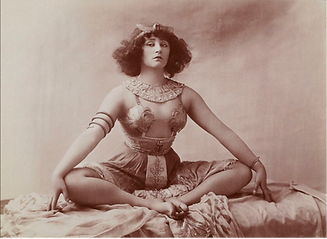
As early as the 19th century, a strange practice flourished throughout the French colonies of North Africa. Travelers, coloniales and Maghrebi women engaged in cross dressing and transcultural disguises, be it in their lives, their artistic production, or their political activity. Drawing on literary and archival case studies from Algeria, Morocco, Tunisia and France, the book examines figures ranging from Parisian garçonnes adopting orientalist aesthetics to express their sexuality to Jewish and Amazigh women concealing their ethnicity to access publication, to Algerian mujahidate dressing as Europeans to cross military checkpoints and fight colonialism at the price of their life. Across the corpus, masquerading women were condemned for their deceitful inauthenticity. In response to such accusations, this study develops the concept of the colonial masquerade to point at the network of imperial pressures, social constraints and moralizing scrutiny that simultaneously produces identity performances and condemns them as false or dangerous. The masquerade reveals the instability of colonial categories themselves, exposing how imperial systems demanded both rigid identities and adaptation. The book ultimately connects these colonial dynamics to contemporary debates over authenticity, identity “imposture,” and national belonging.
Remembering a Bryn Mawr Hero:
Marcelle Pardé's Legacy
An educator, traveler and scholar, Marcelle Pardé was a woman ahead of her time. In 1919, she left her native Burgundy for the United States and joined Bryn Mawr College, where she taught French literature, from 16th century to the modern day for ten years. Upon her return in France, she received an Albert Kahn Fellowship and embarked on a two-year journey through the Middle East. She visited Egypt, Palestine, Lebanon, Syria, Turkey and drove across Iran, from the Caspian Sea to the Indian Ocean, a few years before Annemarie Schwarzenbach and Ella Maillart’s famous crossing of Afghanistan in a Ford Deluxe Roadster.
Marcelle Pardé was also a hero of the Resistance. During the War, she used her function as headmistress to shield Jewish students from the Nazi regime and joined the Brutus network. She was captured by the Gestapo in 1944 along with her secretary Simone Plessis and deported to Ravensbrück in the infamous “convoi des 57,000,” the largest convoy to leave France for Germany during the War. She died in Ravensbrück in 1945.
In collaboration with two Bryn Mawr colleagues and a relative of Marcelle Pardé, I am co-organizing a multiyear tribute to this extraordinary figure. Our project will include a speaker's series, archival seminars, workshops for students and a research project centered on her archive.