Edwige Crucifix
Teaching Philosophy
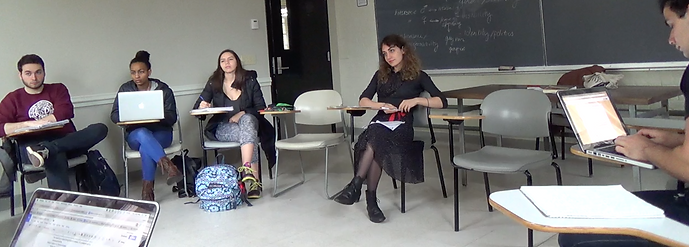
"Introduction to Gender and Sexuality Studies," discussion section. The whole class listens to a student's intervention. Brown University, Spring 2016.
When teaching language, literature or theory, my methods certainly differ, but my ultimate goals remain the same: developing the students’ openness to new or foreign ideas, stimulating their capacity to think critically and hopefully, igniting in them a lifelong love of learning. In fact, it is those very goals that motivate my own scholarly practice and connect my research interests. I believe that teaching is most effective when it takes into account individual backgrounds, and when it strives to create a meaningful exchange. For that reason, I ensure that even lectures remain open to student participation and that class discussions and language sections are always student-centered.
For each of my classes, these general pedagogical objectives translate into clearly-stated course-specific goals to ensure that the students can familiarize themselves with the course material and the methods of a particular discipline. This is reflected in my approach to class assessment: I structure each course and sequence carefully, scaffolding activities inside and outside of class and making sure that students receive actionable feedback from me and from their peers. I find this approach rewarding for both language classes and content courses that require a lot of reading and exposure to new material. For instance, when TAing an advanced literature course on Faulkner, I would regularly ask students to write down three important things they had learned at the end of a section, or to paraphrase quickly the theoretical import of a secondary reading in a minute paper in order to train them to process critical material.
To ensure that the students can fully engage with the material, I am careful to provide them with varied visual, auditory, literary, and theoretical content. In my language classes, I favor original material from the very first levels of proficiency and make sure to engage students with it through all four language skills (writing, speaking, reading and writing). Alongside the lessons and exercises from the textbook, I structure each semester to include class and take-home activities on a feature-length movie and at least one original literary text. In the past, I have successfully worked on the movie L’Auberge Espagnole and Antoine de St Exupéry’s Le Petit Prince with my second-semester students and on the documentary Demain and Maupassant’s Pierre et Jean with my fourth semester students. In my language classes, I like to start out with a “chanson du jour,” which allows for a few informal minutes during which students both settle down and discover a new singer and video clip.
Additionally, I am dedicated to providing my students with opportunities to engage with French language and/or culture outside of class and I have consequently participated to the planning and organization of numerous extra-curricular activities when teaching at Bard College and Brown University, including conversation tables, museum outings, film festivals, French karaoke nights, etc. To that effect, I am also mindful to take recurring yearly events of cultural interest into account when planning the outline of the semester, like the semaine de la Francophonie or the cérémonie des Césars.
Through my experience mentoring students as an instructor and as a journal editor, I have also learned than an effective learning environment is one that improves students’ self-confidence. While I mostly dealt with faculty writers when working for the journal NOVEL, my experience as the Book Reviews Editor for the Graduate Journal for Food Studies, lead me to assist Master’s and PhD students - and occasionally undergraduates - with their first foray into academic publishing. In that position, I was involved in every stage of the writing process with students from diverse disciplines, from Anthropology to Economics, from Public Health to Hispanic studies, and from diverse institutions. As I progressively developed more efficient techniques to give constructive and empowering feedback, I am proud to say that the amount and quality of reviews published by the GJFS increased during the time of my service and gave many of our writers the confidence necessary to seek publication in other venues. The pedagogical skills I gained during my service as an editor have informed my experience as a mentor, whether for guiding undergraduate language TAs or student research. At Brown, I mentored a Master’s student in History on a transcription project concerning French Holocaust victims’ testimonies and had the great joy of guiding her as she turned this material into a brilliant thesis.
Students evaluation of my teaching have been consistently high and faculty who have observed me in the classroom have also given me very favorable assessment. While at Brown, I took full advantage of the Sheridan Center for Teaching and Learning in Higher Education, where I participated in lectures and workshops on pedagogical training and worked as a Teaching Consultant, advising other instructors on their teaching methods. Receiving and giving regular feedback on teaching has allowed me to adopt a critical approach to my own practice and anchor my belief in the all-time relevance of a strong training in the humanities. As a result, my students leave my classes feeling more confident in their autonomous abilities to think critically and to communicate, be it in a foreign language or on complex topics. But most importantly, they are more eager than ever to keep learning.