Edwige Crucifix
Epistemologies of Resistance: Women, Empire, and Knowledge in the Francophone World
Graduate seminar. Taught in French or English.
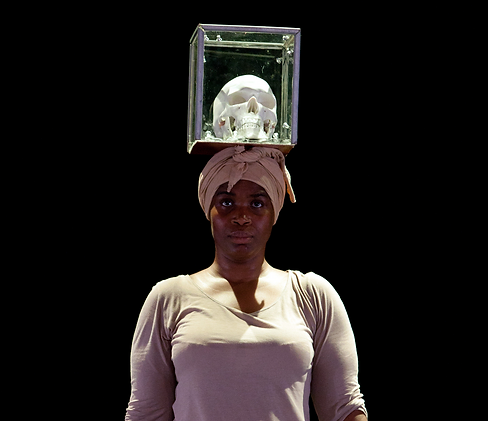
Chantal Loïal, On t’appelle Vénus, 2010.
Dance performance inspired by the life of Sarah Baartman, the "Hottentot Venus."
- Course Outline and Requirements -
Schedule:
This class will meet once a week, for sessions of 150 minutes.
Course Description:
This graduate course explores women’s responses to French imperialism in the modern and contemporary period. It will show how women – traditionally excluded from social and scientific discourse – engaged with alternative modes of knowing and knowledge production to propose an epistemology of resistance against imperial and patriarchal models. Studying the racialized portrayal of “exotic women” in imperial France, the course will focus on the work of postcolonial women writers and artists from sub-Saharan Africa, the Maghreb, and the Caribbean (including Marie-Claire Matip, Angèle Rawiri, Awa Thiam, Safi Faye, Assia Djebar, Eliette Abécassis, Shumona Sinha, Maryse Condé and Evelyne Trouillot). Through various media, we will pay particular attention to the performative dimension of identity, exoticism and otherness in their works to confront current debates about gender and national identity in France and the Francophone world. Informed by global conversations in postcolonial theory, feminism, and race and ethnicity studies (including in the works of Said, Fanon, Spivak, Bhabha, Campt, Tinsley and Abu Lughod), this course will also discuss the overlaps between different colonial and imperial contexts and envision the political potential of such transnational conversations. Taught in French or English.
Required Material:
Most readings and all movies will be made available online by the instructor. Students are responsible for purchasing the following books:
• Matip, Marie-Claire. Ngonda, 1958
• Condé, Maryse. Heremakhonon, 1976.
• Rawiri, Angèle Ntyugwetondo. Fureurs et cris de femme, 1989
• Abécassis, Eliette. La Répudiée, 2000
• Trouillot, Evelyne. Rosalie l’Infâme, 2003.
• Cixous, Hélène. Ayaï !, 2013.
• Sinha, Shumona. Apatride, 2017.
Assignments Sequence:
• Participation (15% of the final grade): Students should contribute actively to the discussions. Students are encouraged to engage directly with their classmates by adding to their remarks, asking questions, or making summary remarks.
• Mid-semester Paper (15% of the final grade): 10 pages.
• In-class presentation (30% of the final grade): Students will choose and assign readings and material for the other members of the seminar and give a 20 min. presentation.
• Final Paper (40% of the final grade): 15-20 pages.
Requirements:
• Readings in French and English will be assigned. All readings must be completed prior to our discussion. Please bring all assigned texts to class.
• All written-work must adhere to the MLA style guidelines. Students unfamiliar with this style might consult the very detailed website of the Purdue Online Writing Lab.
• Attendance is mandatory, however, each student will be permitted three excused absences. Every absence thereafter will result in the deduction of one point off your final grade. Only documented emergencies will be considered excused absences.
• Late assignments will be accepted only if previously discussed with the instructor.
• Academic honesty is required of all students. For more information please refer to the Academic Code of our school, but please see me if you have any doubts or questions.
Diversity and Inclusion statement:
In order for the class to be an equally rich opportunity for all of us to learn, it is essential to respect each other’s perspectives, backgrounds and beliefs. As understanding the particulars of individual experiences is a central feature of Francophone studies and gender and sexuality studies, it is important that the course reflects this commitment. The classroom should be a safe and comfortable environment for all to exchange opinions, ask questions an learn. If you feel like something has been said or done to make you feel uncomfortable in class or in the readings, please contact me or any other trusted facilitator.
Accessibility and Accommodations:
Please inform me early in the term if you have a disability or other conditions that might require accommodations or modification of any of these course procedures. You may speak with me after class or during office hours. For more information, please contact Student and Employee Accessibility Services at XXX-XXX-XXXX.
Students in need of short-term academic advice or support can contact one of the deans in the
Dean of the College office.
- Calendar -
WEEK 1: Race, Gender, Empire: French Taboos?
-
Gobineau, Arthur de. Essai sur l'inégalité des races humaines, 1853-55. (excerpts)
-
Midgley, Clare. Gender and Imperialism, 1998. (excerpts)
-
Peabody, Sue and Tyler Stovall, The color of liberty : histories of race in France, 2003. (excerpts)
-
Chapman, Herrick. Race in France : interdisciplinary perspectives on the politics of difference, 2004 (excerpts)
-
Dorlin, Elsa. La matrice de la race : généalogie sexuelle et coloniale de la nation française, 2006. (excerpts)
WEEK 2: Engaging Critique
-
Said, Edward, Orientalism, 1979. (excerpts)
-
Haraway, Donna. “Situated Knowledges: The Science Question in Feminism and the Privilege of Partial Perspective,” Feminist Studies, 1988.
-
Tuhiwai Smith, Linda. Decolonizing Methodologies, 1999 (excerpts)
-
Foucault, Michel. “What is Enlightenment?,” The Foucault Reader, ed. Paul Rabinow, 1984.
-
Foucault, Michel. “What is critique?,” The Politics of Truth, 1997.
WEEK 3: Performing Difference
-
Representations of Saartjie/Sarah Baartman (Cuvier ; prints ; plays; dance, etc.)
-
Rhaïs, Elissa. Le Café-chantant. Kerkeb. Noblesse arabe, 1920. (selected short stories)
-
Apter, Emily. “Ethnographic Travesties, Alibis of Gender and Nation in the Case of Elissa Rhaïs,” Continental drift: From national characters to virtual subjects, 1999.
-
Fanon, Frantz. Peau Noire, Masques Blancs, 1952. (excerpts)
-
Bhabha, Homi. The Location of Culture, 1994.(excerpts)
-
Ferguson, Roderick. “Toward the End of Normativity,” Aberrations in Black, 2004.
WEEK 4: Desire and Abjection
-
Abécassis, Eliette. La Répudiée, 2000
-
Abécassis, Eliette. Sépharade, 2009 (performance)
-
Trouillot, Evelyne. Rosalie l’Infâme, 2003
-
Traoré, Apolline. Moi Zaphira, 2013. (film)
-
Kristeva, Julia. Pouvoirs de l’Horreur, 1980. (excerpts)
-
Campt, Tina. Listening to Images, 2017. (excerpts)
WEEK 5: Troubling Sexuality
-
Condé, Maryse. Heremakhonon, 1976.
-
Rawiri, Angèle Ntyugwetondo. Fureurs et cris de femme, 1989.
-
Cixous, Hélène. Ayaï !, 2013.
-
Sedgwick, Eve. Epistemology of the Closet, 1990. (excerpts)
-
Tinsley, Omise'eke Natasha. “Black Atlantic, Queer Atlantic: Queer Imaginings of the Middle Passage,” GLQ, 2008.
WEEK 6: Economics of Exploitation
-
Matip, Marie-Claire. Ngonda, 1958.
-
Faye, Safi, Kaddu Beykat, 1975. (film)
-
Sinha, Shumona. Apatride, 2017.
-
Condé, Maryse. “Order, Disorder, Freedom, and the West Indian Writer,” Yale French Studies, 1993.
WEEK 7: Speaking, Inside Out: Literature and Anthropology
-
Thiam, Awa. La Parole aux négresses, 1978.
-
Spivak, Gayatri. “Can the Subaltern Speak?,” 1988
-
Mernissi, Fatema. Scheherazade Goes West, 2000.(excerpts)
-
Mahmood, Saba. Politics of Piety, 2004. (excerpts)
-
Abu Lughod, Lila. Writing Women's Worlds: Bedouin Stories, 2008.(excerpts)
-
Postcolonial feminist collectives : Ni putes ni soumise, Mwasi, etc.
WEEK 8 : Student Presentation
WEEK 9 : Student Presentation
WEEK 10: Student Presentation
WEEK 11 : Student Presentation
WEEK 12 : Student Presentation
WEEK 13: Student Presentation